Skip to content
Summary
The pelvic floor is a group of muscles that plays an important role in bladder and bowel control, sexual
function, pelvic organ support and core stability. But when something feels wrong in this area, it is not
always easy to know whether your pelvic floor is too weak, too tight, or simply not coordinating
properly.
You may have been told to do pelvic floor exercises because you are leaking urine, experiencing
pelvic heaviness or recovering after childbirth. On the other hand, you may be experiencing pelvic
pain, pain during sex, difficulty relaxing to empty your bladder or bowel, or a feeling of constant
tension in your pelvis.
These symptoms can sometimes be caused by a pelvic floor that is overactive rather than weak.
The important thing to understand is that pelvic floor muscles need to be able to do both: contract
when you need support and relax when you need to release tension.
At My French Physio, our Women’s Health Physiotherapists assess the pelvic floor as part of the
wider body rather than looking at the muscles in isolation. This helps us understand whether your
symptoms are related to weakness, increased muscle tension, poor coordination, or a combination of
factors, and create an individual treatment plan.
What Does the Pelvic Floor Actually Do?
Your pelvic floor is a group of muscles located at the base of your pelvis. They help support the
bladder, bowel and reproductive organs and contribute to continence, sexual function and pressure
management within the abdomen.
Think of your pelvic floor less like a muscle that should simply be “strong” and more like a muscle
group that needs to be strong, flexible and responsive.
A healthy pelvic floor should be able to:
● Contract when you need to prevent urine or stool leakage
● Relax when you empty your bladder or bowel
● Lengthen and relax during penetration and sexual activity
● Respond to coughing, sneezing, lifting and exercise
● Support the pelvic organs
● Coordinate with your breathing and abdominal muscles
● Adapt to different activities and pressures
This is why pelvic floor health is not simply about doing more Kegel exercises.
For some people, the problem is that the muscles do not generate enough force. For others, the
muscles are working too hard and do not relax properly. And for some people, both problems can
exist at the same time.
Signs Your Pelvic Floor May Be Too Weak
Pelvic floor weakness can develop for many different reasons, including pregnancy and childbirth,
hormonal changes, ageing, surgery, changes in physical activity or repeated increases in pressure
through the abdomen.
Common symptoms may include:
● Leaking urine when coughing, sneezing or laughing
● Urine leakage during running, jumping or exercise
● Difficulty controlling wind or bowel movements
● A feeling of heaviness or pressure in the vagina
● A sensation of something “dropping” or bulging
● Reduced support or control during physical activity
● Difficulty maintaining a pelvic floor contraction
● A feeling that the pelvic floor “gives way” under pressure
Some women notice symptoms only during exercise, while others experience them during everyday
activities.
For example, you may be completely continent while sitting at your desk but leak a small amount of
urine when you run, jump on a trampoline or sneeze.
This does not necessarily mean that your pelvic floor is simply “weak”. It may mean that the muscles
need to improve their strength, endurance, timing or coordination with the rest of your body.
Signs Your Pelvic Floor May Be Too Tight or Overactive
A pelvic floor that is too tight can create a very different set of symptoms.
You may experience:
● Pain during or after sex
● Difficulty tolerating penetration
● Pelvic or vaginal pain
● A feeling of pressure or tension in the pelvis
● Difficulty relaxing the pelvic floor
● Pain with sitting
● Urinary urgency or discomfort
● Difficulty starting or maintaining a urine stream
● Difficulty fully emptying your bladder
● Constipation or difficulty relaxing to empty your bowel
● Pain around the vulva, vagina, perineum or rectum
● Increased pelvic pain during periods or certain activities
Some women describe the sensation as constantly “clenching” their pelvic floor without consciously
trying to.
Others may not realise they are holding tension until they begin paying attention to their breathing,
posture or symptoms.
A tight pelvic floor is not necessarily a stronger pelvic floor.
In fact, a muscle that is constantly contracted may have difficulty producing an effective contraction
when you actually need it.
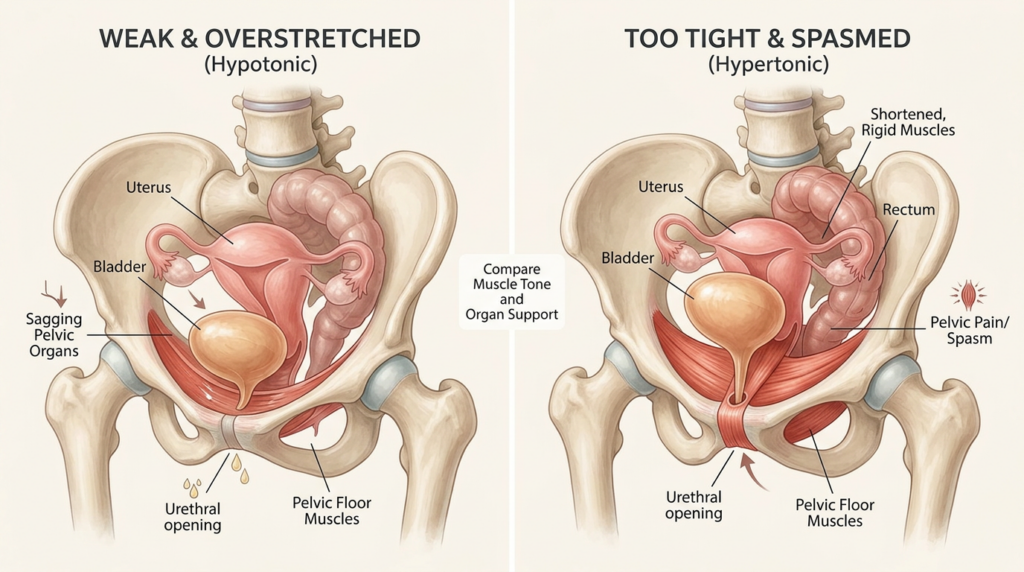
Can My Pelvic Floor Be Both Tight and Weak?
Yes.
This is one of the most important things to understand about pelvic floor rehabilitation.
A muscle can be overactive and still not function effectively.
Imagine keeping your shoulders slightly raised and tense all day. You are using those muscles
constantly, but that does not necessarily mean they are functioning well. They may become tired,
painful or less efficient when you need them to perform a specific movement.
The pelvic floor can behave in a similar way.
For example, someone may have a pelvic floor that is very tense at rest but still experience urine
leakage when running. In this situation, doing more and more strengthening exercises without
addressing the muscle tension may not solve the underlying problem.
This is why a proper assessment is more useful than trying to diagnose yourself based on one
symptom.
Why Does the Pelvic Floor Become Too Tight?
There is rarely one single explanation.
Pelvic floor muscle tension can be associated with:
● Persistent pelvic pain
● Previous pelvic surgery
● Pregnancy or childbirth
● Pain during sex
● Repeatedly holding in urine or stool
● Constipation and straining
● Stress and increased muscle guarding
● Previous painful experiences involving the pelvis
● High training loads or changes in exercise
● Hip or lower back problems
● Other pelvic or gynaecological conditions
Sometimes the muscles become protective in response to pain or irritation.
This does not mean that the pain is “in your head”. Persistent pelvic symptoms are real and deserve
appropriate assessment.
The nervous system, muscles, joints and internal organs can all influence how the pelvic area feels
and functions.
Why Does the Pelvic Floor Become Weak?
Pelvic floor function can also change when the muscles are unable to generate enough force or
coordinate effectively.
Potential contributing factors include:
● Pregnancy
● Vaginal childbirth
● Pelvic surgery
● Changes associated with menopause
● Reduced physical activity
● Repeated increases in abdominal pressure
● Previous pelvic injury
● Changes in muscle strength with ageing
However, weakness is not always the only problem.
For example, if you leak urine when you run, your physiotherapist may assess not only your pelvic
floor strength but also your breathing, abdominal pressure management, hip strength, movement
patterns and running technique.
The goal is not simply to make one muscle stronger. It is to help your whole body work efficiently
together.
How Can I Tell Which One I Have?
Unfortunately, there is no reliable home test that can tell you whether your pelvic floor is too tight or
too weak.
Your symptoms can provide useful clues, but they do not give the complete picture.
For example
Leaking urine can occur with reduced pelvic floor strength, but it can also be influenced by poor
timing, pressure management or other factors.
Pain during sex can be associated with pelvic floor overactivity, but there can also be other causes
that need to be considered.
Pelvic heaviness may be associated with reduced support, but it does not automatically mean that
your pelvic floor is weak.
This is why assessment matters.
A pelvic health physiotherapist may assess:
● Your symptoms and medical history
● Bladder and bowel habits
● Sexual function, where relevant
● Breathing patterns
● Posture and movement
● Hip and lower back function
● Abdominal muscle control
● Pelvic floor contraction
● Pelvic floor relaxation
● Muscle coordination
● Areas of tenderness or increased tension
With your informed consent, an internal pelvic floor examination may sometimes be recommended.
This can help assess muscle tone, tenderness, contraction and relaxation.
However, an internal examination is not compulsory and should only be performed when appropriate
and when you are comfortable with it.
What Happens If My Pelvic Floor Is Too Tight?
If your assessment suggests that your pelvic floor is overactive, treatment will usually focus on helping
the muscles relax and coordinate, rather than simply strengthening them.
Treatment may include:
Breathing and Relaxation
Your breathing and pelvic floor are closely connected.
Learning how to breathe without constantly bracing your abdominal or pelvic muscles can be an
important part of rehabilitation.
Your physiotherapist may teach you breathing strategies and exercises designed to reduce
unnecessary pelvic floor tension.
Pelvic Floor Relaxation
You may need to learn how to recognise tension and allow the pelvic floor to lengthen and relax.
This can be particularly important if you have difficulty relaxing during urination, bowel movements or
sexual activity.
Manual Therapy
Where appropriate, hands-on treatment may be used to address muscle tension and improve
movement around the pelvis.
This can include external soft tissue techniques and, when appropriate and with informed consent,
internal pelvic floor treatment.
Hip and Lower Back Mobility
The pelvic floor does not work in isolation.
Your physiotherapist may assess your hips, pelvis and lower back and include mobility or movement
exercises in your programme.
Gradual Return to Activity
You usually do not need to stop exercising completely.
Instead, the goal is often to identify activities that aggravate symptoms and gradually rebuild your
tolerance.
What Happens If My Pelvic Floor Is Weak?
If your assessment identifies reduced strength or control, your programme may include pelvic floor
strengthening.
This might involve:
● Learning how to correctly contract the pelvic floor
● Improving contraction strength
● Building endurance
● Practising quick contractions
● Coordinating the pelvic floor with breathing
● Training the muscles for coughing, lifting or exercise
● Gradually increasing the demands placed on the muscles
The exercises should be specific to your symptoms and goals.
Doing hundreds of repetitions every day is not necessarily better.
Good pelvic floor rehabilitation is about quality, coordination and progression, rather than simply
doing more exercises.
What If I Am Not Sure?
You do not need to work this out by yourself.
If you have symptoms such as leaking, pelvic pain, heaviness, urgency, difficulty emptying your
bladder or bowel, or pain during sex, a pelvic health physiotherapy assessment can help identify what
may be contributing to the problem.
Sometimes the answer is not “tight” or “weak”.
It may be:
“Your pelvic floor needs to learn when to contract and when to relax.”
That distinction can completely change the treatment approach.
Should I Stop Doing Kegels?
Not necessarily.
Pelvic floor strengthening exercises can be very helpful for some people. However, they are not
appropriate for everyone.
If your pelvic floor muscles are already overactive or tight, repeatedly strengthening them without
addressing the underlying tension may aggravate your symptoms.
The right exercise depends on what your pelvic floor actually needs.
This is why an individual assessment is preferable to following a generic online pelvic floor exercise
programme.
Red Flags: When Should You Seek Medical Advice?
Pelvic symptoms should be assessed if they are severe, persistent, unexplained or affecting your
daily life.
Seek medical attention if you experience symptoms such as:
● New loss of bladder or bowel control
● Numbness around the saddle area
● Progressive weakness in the legs
● Severe pain following significant trauma
● Fever or feeling generally unwell alongside pelvic pain
● Blood in your urine or stool
● Unexplained vaginal bleeding
● Severe or worsening pain during pregnancy or after childbirth
These symptoms can have causes that require medical investigation rather than physiotherapy alone.
Frequently Asked Questions
Can a tight pelvic floor cause bladder problems?
Yes. An overactive pelvic floor can contribute to urinary urgency, discomfort and difficulty relaxing
during bladder emptying. However, urinary symptoms can have many different causes, so an
appropriate assessment is important.
Can a weak pelvic floor cause pelvic pain?
It can be associated with pelvic symptoms, but pelvic pain is not automatically caused by weakness.
Pain may involve muscle tension, nerve sensitivity, joints, organs or several factors at once.
If I leak urine, does that mean my pelvic floor is weak?
Not necessarily. Leakage can be related to strength, endurance, timing, coordination and how your
pelvic floor responds to pressure and movement.
Can I have a tight pelvic floor and still leak urine?
Yes. A pelvic floor can be overactive but still have difficulty responding effectively during activities
such as coughing, jumping or running.
Should I do pelvic floor exercises every day?
Not automatically. The appropriate frequency and type of exercise depend on your assessment,
symptoms and goals.
Is pelvic floor physiotherapy only for women after childbirth?
Absolutely not.
Pelvic health physiotherapy can be useful at many stages of life, including before and during
pregnancy, after childbirth, around menopause and beyond.
It can also help with urinary symptoms, bowel problems, pelvic pain, sexual pain and difficulties
related to pelvic floor muscle coordination.
Do I need an internal examination?
Not necessarily.
An internal assessment can provide useful information in some cases, but it is never something you
should feel pressured to do. Your physiotherapist should explain why it may be recommended and
obtain your informed consent.
A Multidisciplinary Approach
Pelvic floor symptoms do not always have a single cause.
Depending on your symptoms, your physiotherapist may work alongside other healthcare
professionals, such as your GP, gynaecologist, urologist or other specialist.
Physiotherapy can form one part of a wider approach to improving pelvic health and quality of life.
The goal is not simply to label your pelvic floor as “tight” or “weak”.
The goal is to understand why it is behaving the way it is and what it needs to function better.
Conclusion
Your pelvic floor is not simply a muscle that needs to be made stronger.
It needs to be able to contract, relax, lengthen, coordinate and respond to the demands placed
on your body.
If you experience leaking, pelvic heaviness or difficulty controlling your bladder or bowel, your pelvic
floor may need more strength or better coordination.
If you experience pelvic pain, pain during sex, urinary urgency, difficulty emptying your bladder or
bowel, or a feeling of constant tension, your pelvic floor may be too active and need help learning to
relax.
And sometimes, you can have elements of both.
If you are unsure what your pelvic floor needs, an assessment with a Women’s Health Physiotherapist
can help you understand what is happening and guide you towards the most appropriate treatment.
You don’t have to guess whether your pelvic floor is too tight or too weak. An individual
assessment can help you find out — and give you a plan that is right for your body.
At My French Physio, we take the time to understand your symptoms, your goals and the factors
contributing to them, before creating a personalised treatment programme.